Overall
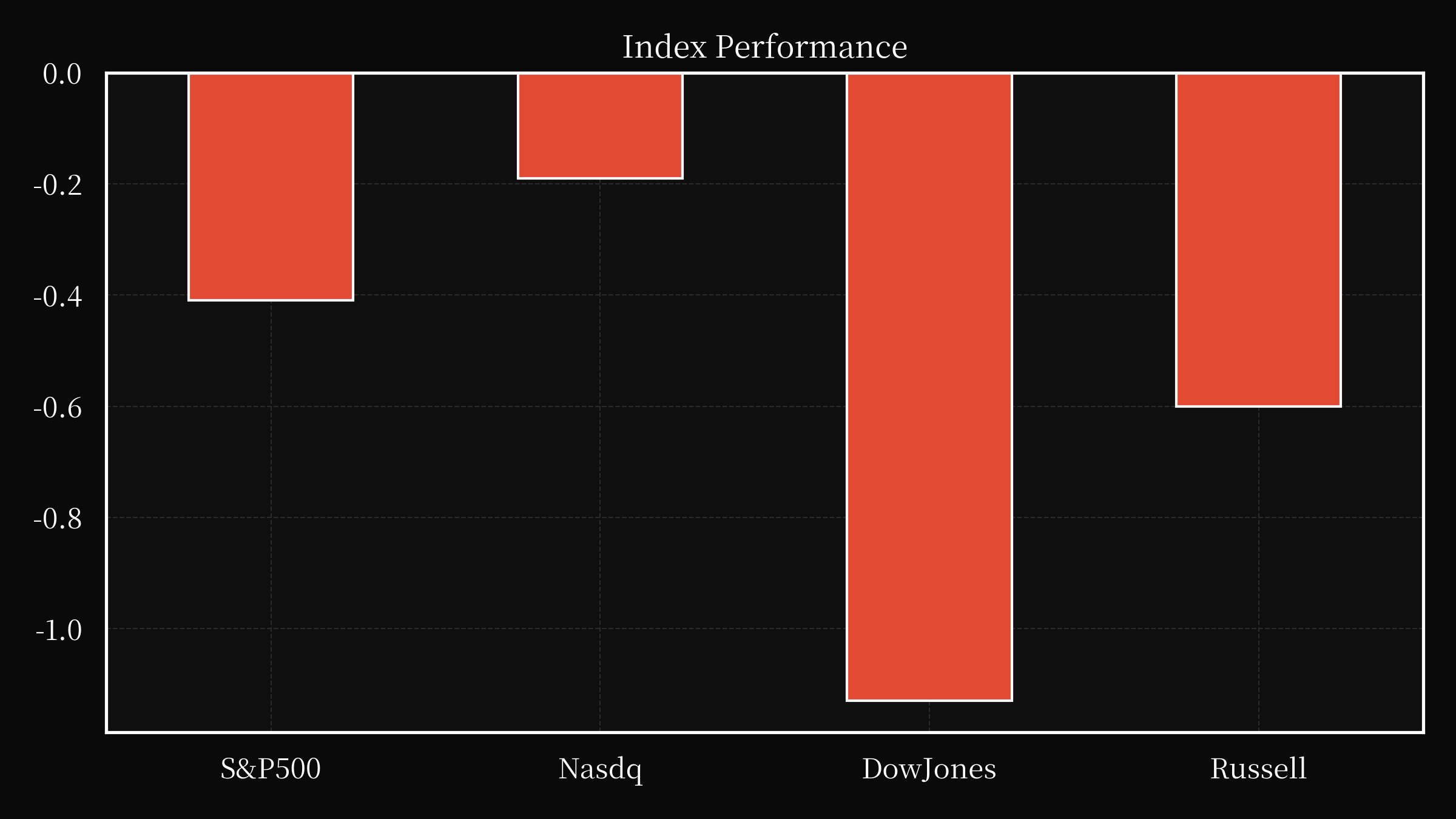
Markets closed with a pronounced sell-off as geopolitical tensions in the Middle East triggered a flight to safety, with the Dow Jones Industrial Average and S&P 500 posting losses amid heightened concerns over oil supply disruptions. The conflict between Iran and the UAE, marked by missile and drone attacks on critical infrastructure, directly impacted global energy markets, pushing Brent crude to $114 per barrel and U.S. oil futures to $106. This surge in commodity prices, coupled with the broader risk-off sentiment, eroded investor confidence across equities, particularly in sectors sensitive to energy costs and global trade flows. Transportation stocks, including industry leaders like United Parcel Service and FedEx, faced significant declines as supply chain uncertainties intensified, reflecting the cascading effects of regional instability on operational costs and demand forecasts.
The U.S. equity market’s underperformance was further exacerbated by mixed earnings reports and cautious guidance from key players, while corporate actions such as GameStop’s $56 billion acquisition offer for eBay underscored the divergent fortunes within the tech sector. GameStop’s stock collapsed 10% following the announcement, exposing vulnerabilities in its business model and raising questions about its ability to finance such a transaction. Concurrently, Palantir’s robust earnings performance, though positive, failed to catalyze sustained investor enthusiasm, highlighting the market’s skepticism toward growth narratives without clear paths to profitability.
Corporate disclosures and macroeconomic data releases added layers of complexity to the market’s trajectory. Norwegian Cruise Lines’ warning about reduced demand due to geopolitical risks and rising fuel costs signaled broader sectoral challenges, particularly for discretionary travel and leisure companies. Meanwhile, the U.S. trade balance, job openings, and new home sales data loomed as critical indicators of economic momentum, with Federal Reserve officials scheduled to provide insights into monetary policy, potentially influencing interest rate expectations. The interplay between these factors reinforced a cautious tone, as investors recalibrated risk assessments amid overlapping global and domestic headwinds.
The equity market’s retreat also reflected evolving dynamics in technology and innovation-driven sectors. While artificial intelligence and automation continued to attract capital, concerns over labor market shifts and regulatory scrutiny tempered optimism. Studies on immigration policy’s impact on employment revealed nuanced outcomes, suggesting that stricter enforcement did not necessarily translate to improved opportunities for native workers, complicating narratives around protectionist measures. Additionally, the performance of ETFs and sector-specific plays, such as semiconductor manufacturers and energy infrastructure providers, illustrated the fragmented nature of market reactions, with some stocks benefiting from volatility while others lagged.
Institutional investors and analysts emphasized the need for a balanced approach to portfolio management, weighing short-term risks against long-term opportunities. The convergence of geopolitical volatility, inflationary pressures, and corporate earnings variability underscored the importance of diversification and adaptive strategies. As markets navigated these challenges, the emphasis shifted toward resilience—whether through hedging against energy price swings, capitalizing on technological advancements, or reassessing exposure to regions vulnerable to geopolitical friction. The day’s developments reinforced the interconnectedness of global events and financial markets, with implications for both immediate performance and strategic positioning in an increasingly uncertain economic landscape.
The broader implications of these trends extended beyond equity markets, influencing sectors such as manufacturing, logistics, and consumer discretionary spending. Rising input costs, supply chain disruptions, and shifting consumer behavior patterns created a complex environment for businesses, necessitating agile responses to maintain margins. Meanwhile, the divergence in performance between large-cap and small-cap stocks, as well as between cyclical and defensive sectors, highlighted the evolving risk appetite of investors. These dynamics, compounded by central bank policy signals and fiscal developments, set the stage for continued volatility, requiring vigilant monitoring and proactive adjustments to navigate the shifting landscape effectively.
Ultimately, the market’s reaction to the day’s events underscored the fragility of investor sentiment in the face of multifaceted risks. While some segments demonstrated resilience through innovation and adaptability, others remained exposed to external shocks, reinforcing the necessity of a nuanced understanding of macroeconomic forces and corporate fundamentals. As stakeholders evaluated these developments, the emphasis on data-driven decision-making and scenario planning became paramount, ensuring that portfolios remained aligned with both immediate challenges and long-term objectives in an era of heightened uncertainty.
The interplay between geopolitical tensions, corporate earnings, and macroeconomic indicators painted a picture of a market in transition, where traditional benchmarks and emerging trends coexisted amid a backdrop of persistent volatility. The lessons from this session highlighted the importance of flexibility, as investors sought to reconcile conflicting signals and position themselves for potential inflection points. Whether through sector rotation, geographic diversification, or enhanced risk management practices, the path forward demanded a proactive stance, recognizing that the convergence of global events and market mechanics would continue to shape outcomes in the weeks and months ahead.
In conclusion, the day’s market activity served as a microcosm of the broader economic landscape, where interconnected risks and opportunities required careful navigation. The emphasis on resilience, adaptability, and informed decision-making became evident, as participants grappled with the implications of a rapidly evolving environment. By synthesizing these elements, investors could better anticipate shifts, mitigate exposures, and capitalize on emerging trends, ensuring that their strategies remained robust in the face of ongoing uncertainty. The interplay of these factors reinforced the enduring relevance of fundamental analysis, contextual awareness, and strategic foresight in an era defined by complexity and change.
Watch List
GBDC
Golub Capital BDC, Inc., a business development company, reported its financial results for the second fiscal quarter ending March 31, 2026. The portfolio maintained strong performance with approximately 89% of investments rated '4' or '5', indicating solid internal ratings. Despite an increase in non-accrual investments to 1.4%, they remained low at 2.3% on a cost basis. The company's net asset value per share decreased by $0.49, from $14.84 to $14.35 over the quarter. The investment portfolio stood at approximately $8.3 billion in fair value, with significant exits and sales amounting to $336.6 million and new commitments of $17.7 million. In response to market dislocation affecting public BDC equity, Golub Capital prioritized share repurchases, buying back 2.2 million shares for $27.8 million at an average price of $12.43 per share. The GAAP debt-to-equity ratio remained stable at 1.24x, with a significant portion of its debt being floating rate and well-laddered. Net investment income was solid at $0.34 per share, though impacted by sector headwinds like delayed interest rate cuts from the previous quarter. Earnings per share were negatively affected by market-driven credit spread widening, resulting in net unrealized losses on investments, particularly those performing highly within the portfolio. The company declared a quarterly
AVNW
Aviat Networks Inc., a leader in wireless transport and access solutions, announced its fiscal 2026 third quarter results for the period ending March 27, 2026. The company reported total revenues of $100 million, marking an 11.2% decrease from the previous year's third quarter due to timing issues with private and mobile network projects in North America and international revenue delays linked to geopolitical tensions in the Middle East. Despite these challenges, North American revenue saw a modest increase of 1.4%, while international revenues declined by 14.9%. The company experienced a GAAP gross margin decrease from 34.9% to 29.3% compared to the prior year's third quarter, primarily due to changes in regional and product mix. However, for the nine months ended March 27, 2026, Aviat reported an improvement in both GAAP and non-GAAP gross margins by 40 and 0 basis points respectively. Operating expenses were reduced significantly, with GAAP operating expenses down by $1.7 million and non-GAAP expenses decreasing by $0.8 million compared to the same period last year. This contributed to a GAAP operating income of $0.9 million for the quarter, although it was lower than the previous year's figure due to reduced gross margin dollars. Net loss for the third quarter stood at $(2.1) million or $(0.16) per diluted share on a GAAP basis, contrasting with net income in
WGRX
In the recent SEC filing, the company disclosed significant developments that reflect its current financial and operational status. The document highlights a notable increase in revenue, driven by robust sales performance across key product lines and successful market expansion strategies. This growth is attributed to both organic factors and strategic acquisitions that have enhanced the company's competitive edge. Additionally, there has been a substantial investment in research and development, aimed at fostering innovation and maintaining technological leadership within the industry. The filing also addresses cost management efforts, which include streamlining operations and optimizing supply chain efficiencies. These measures are designed to improve profitability margins despite rising raw material costs and logistical challenges. The company's financial health is further supported by a strong balance sheet, characterized by an increase in cash reserves and a reduction in debt levels, positioning it well for future investments. On the operational front, the company has expanded its global footprint through strategic partnerships and entering new markets, which are expected to drive long-term growth. However, challenges remain, including regulatory uncertainties and competitive pressures that could impact market dynamics. The management remains optimistic about navigating these challenges, emphasizing a commitment to shareholder value through sustainable practices and prudent financial management. Overall, the SEC filing paints a picture of a company on an upward trajectory, with solid financial foundations and strategic initiatives in place to capitalize on growth opportunities while mitigating risks.
ELS
Clover Leaf Farms, a subsidiary of ELS, is highlighted in its investor presentation for May 2026 as part of the company's diverse portfolio. ELS operates a high-quality collection of manufactured home communities, RV resorts, campgrounds, and marinas across North America, boasting an impressive presence with over 173,419 sites spanning 35 states and one Canadian province. As of March 31, 2026, ELS has demonstrated strong financial performance as an S&P 400 member. The company reported $15.8 billion in enterprise value and a ten-year total return of 174%, outperforming the S&P 500's 72% and Dow Jones Equity ALL REIT Index's 173%. Revenue is predominantly derived from stable, annual sources, accounting for approximately 92% of its income. The company's balance sheet remains robust with an 8.2% normalized FFO/share CAGR from 2006 to 2025 and a dividend/share CAGR of 19% over the same period. ELS maintains a strategic focus on long-term growth through acquisitions, development, and leveraging technology for operational efficiency. For 2026, ELS has set its annual dividend rate at $2.17 per share, marking a 5.3% increase from the previous year. The company's business model emphasizes owning land and leasing developed sites, ensuring consistent results across real estate cycles due to strong customer demand with minimal new supply. ELS continues to expand through
BYNOW
In the recent SEC filing, the company disclosed significant developments that reflect its strategic direction and financial health. The report highlights a series of transactions aimed at optimizing the company's asset portfolio, including divestitures and acquisitions that are expected to enhance operational efficiency and drive long-term growth. Notably, the company has successfully completed the sale of several non-core assets, generating substantial capital that will be reinvested in high-potential areas aligned with its core business objectives. Additionally, the filing outlines a major acquisition intended to expand the company's market presence and diversify its product offerings. This strategic move is anticipated to provide synergies that will bolster competitive advantage and improve profitability margins. The integration plan for this acquisition has been meticulously detailed, emphasizing efforts to streamline operations and achieve cost efficiencies. Financially, the report provides an update on the company's performance metrics, indicating a robust revenue growth trajectory despite challenging market conditions. Earnings have shown resilience, supported by disciplined cost management and strategic investments in innovation. The company remains committed to delivering shareholder value through sustainable financial practices and prudent capital allocation. Furthermore, the filing addresses governance changes, including appointments to key executive positions that are expected to strengthen leadership capabilities and drive future growth initiatives. These changes underscore the company's dedication to maintaining a strong corporate governance framework. Overall, the SEC filing paints a picture of a proactive organization strategically positioning itself for sustained success by leveraging strategic transactions, enhancing operational efficiencies, and focusing on long-term value creation for its stakeholders.
VABK
On May 4, 2026, Virginia National Bankshares Corporation announced that its wholly owned subsidiary, Fauquier Bank Services, Inc., successfully completed the sale of its interest in Bearing Insurance Group, LLC. This transaction marks a strategic divestiture for FBS, which operates as a full-service insurance agency. The completion date for this sale was May 1, 2026. As part of this financial maneuver, Virginia National anticipates realizing a significant pre-tax gain of approximately $4.7 million from the sale. This anticipated gain is expected to positively impact the company's operating results and will be reflected in their financial statements for the second quarter of 2026. This development underscores the Company’s ongoing efforts to optimize its portfolio and enhance shareholder value through strategic asset management.
STBA
McComish Corporation, founded in 1902 in Indiana, PA, reported its first-quarter financial performance for 2026 with Mark Kochvar as CEO and a CFO leading the charge. The company holds $9.9 billion in assets, including $8.2 billion in deposits and $8.0 billion in loans, boasting a market capitalization of $1.5 billion under the stock symbol STBA. Serving over 131,000 households across Pennsylvania and Ohio, McComish employs around 1,200 team members at more than 70 locations. The strategic focus for McComish is on sustainable growth through disciplined credit risk management and customer-centric strategies. The company aims to enhance its deposit franchise by leveraging Treasury Management solutions and digital offerings while maintaining strong asset quality. Performance metrics indicate a robust financial position with net income of $35.1 million, earnings per share (EPS) at $0.94, and return on average tangible equity at 13.22%. The firm's nonperforming assets have declined, reflecting improved credit risk management practices. McComish's loan portfolio is diversified, with significant allocations in commercial real estate and consumer loans. The deposit base remains strong and well-diversified, contributing to a stable funding position. The company maintains strategic flexibility through capital management initiatives, including share repurchases and dividend increases. With a focus on organic growth and selective mergers and acquisitions, McComish is strategically positioned for future expansion while ensuring alignment with its core values
RM
On April 28, 2026, Regional Management Corp. (RMC) and several of its subsidiaries executed multiple amendments to their existing credit agreements as part of a strategic financial restructuring effort. The First Amendment to the Senior Revolving Credit Facility was signed by RMC, its subsidiary borrowers, associated lenders, and Bank of Montreal acting as agent. This amendment modifies the original Loan and Security Agreement dated August 19, 2025, specifically addressing changes related to the pledge of receivables originated by a bank partner under certain conditions. In parallel, amendments were made to several warehouse facilities: RMR IV, V, VI, and VII. Each facility underwent specific adjustments to their respective Credit Agreements: 1. RMR IV Amendment: This amendment updated definitions such as "Concentration Limits" and "Maturity Date," added subsidiaries to the definition of "Originator," extended the revolving period end date to May 2027, and adjusted terms related to receivables pledged by bank partners. 2. RMR V Amendment: Similar structural changes were made to this facility's Credit Agreement, though specific details are incorporated in Exhibit 10.3. 3. RMR VI Amendment: This amendment involved updates to definitions including "Concentration Limits" and extended the maturity date to May 2028, with further specifics detailed in Exhibit 10.4. 4. RMR VII Amendment: Notable changes included a reduction of the advance rate from 76.0%
DORM
Dorman Products, Inc., a leading supplier in the motor vehicle aftermarket industry, reported first-quarter results for 2026 with net sales of $528.8 million, marking a 4.2% increase from the previous year. However, diluted earnings per share (EPS) decreased by 24% to $1.43, while adjusted EPS fell by 22% to $1.57, primarily due to higher costs from tariffs implemented in 2025. Despite these challenges, Dorman generated $43.8 million in cash from operations and repurchased $51 million of its shares at an average price of $118 each. Kevin Olsen, Chairman, President, and CEO, highlighted the company's solid financial performance amidst economic and geopolitical uncertainties, reaffirming full-year guidance for 2026 across all segments. Gross profit was reported at $36% of net sales, down from 41% in the prior year, while selling, general, and administrative expenses increased slightly as a percentage of net sales. The company's strategy focuses on innovation leadership in the aftermarket sector, aiming to navigate market dynamics effectively and support long-term growth. Dorman continues to offer a broad range of aftermarket replacement products designed for convenience and reliability across various vehicle types. In addition to GAAP financial measures, Dorman provides non-GAAP metrics to give investors additional insights into its performance and profitability trends. These include adjustments for acquisition-related costs and other one-time expenses, reflecting management's approach to evaluating ongoing business operations
OI
On May 4, 2026, O-I Glass, Inc., through its subsidiary Owens-Brockway Glass Container Inc. (OBGC), announced plans to issue $500 million in senior notes due 2033 as part of a private offering. The Offering was priced at par with a 9.5% interest rate and is guaranteed by Owens-Illinois Group, Inc. and certain subsidiaries under its credit agreement. This issuance aims to close on May 18, 2026, contingent upon customary conditions being met. The proceeds from this Offering are intended for the redemption of OBGC's outstanding $612 million in 6.625% Senior Notes due 2027, with a conditional notice of full redemption issued following the pricing announcement. The redemption is dependent on the successful completion of the Offering to an extent satisfactory to OBGC. Issuance and guarantees related to these notes are subject to registration requirements under U.S. securities laws unless exempted. This report serves informational purposes only and does not constitute a formal offer or solicitation for sale. The Company acknowledges various risks that could impact its financial performance, including market conditions, supply chain disruptions, competitive pressures, technological advancements, operational challenges, regulatory changes, and geopolitical factors. These forward-looking statements are based on current expectations and assumptions but do not guarantee future outcomes, as actual results may vary significantly due to unforeseen developments. The report is signed by an authorized representative of O-I Glass, Inc., confirming its compliance with SEC filing