Overall
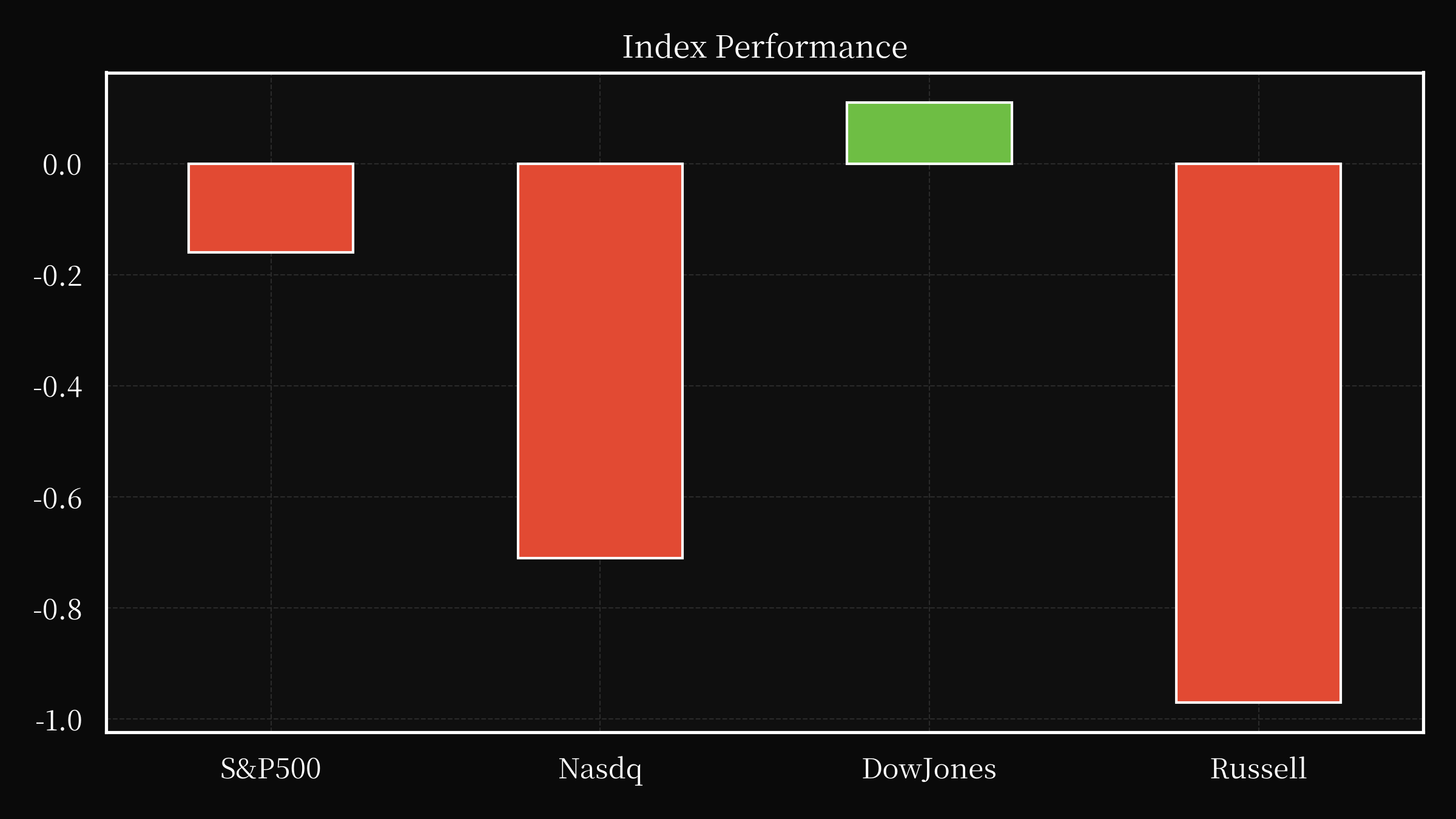
The market experienced a notable reversal on Tuesday, with the S&P 500 and Nasdaq Composite posting modest declines amid a broader shift in investor sentiment. The S&P 500 slipped 0.2%, while the Nasdaq fell 0.7%, contrasting sharply with the gains of the previous session. The Dow Jones Industrial Average, however, edged higher by 0.1%, reflecting a mixed picture across sectors. This divergence was most pronounced in the semiconductor industry, where major players such as Qualcomm, Intel, and Sandisk led the index lower, contributing to a 3% drop in the PHLX Semiconductor Index. The weakness in tech stocks was not isolated, as broader market participants reassessed risk exposure following a week of aggressive rallies driven by artificial intelligence optimism. The shift was further underscored by the performance of consumer discretionary and risk-off sectors, which outperformed the more volatile growth-oriented segments.
The macroeconomic backdrop intensified concerns about inflationary pressures, with the Bureau of Labor Statistics reporting a 3.8% year-over-year increase in the consumer price index for April, surpassing wage growth of 3.6%. This gap, exacerbated by rising fuel costs, signaled a sustained challenge for households and businesses alike. The Federal Reserve’s upcoming policy decisions, particularly the transition to Kevin Warsh as chair, added layers of uncertainty to market expectations. The CPI data also highlighted the Federal Reserve’s dual mandate dilemma, as policymakers weighed the risks of persistent inflation against the potential for economic slowdown. The interplay between monetary policy and fiscal dynamics, including the ongoing U.S.-Iran tensions, created a volatile environment where traditional asset allocations faced reevaluation.
Energy markets remained a critical focal point, with crude oil prices climbing 4.2% to $102.18 per barrel, directly influencing transportation costs and consumer spending. Gasoline prices, now averaging $4.50 per gallon, reflected the direct impact of geopolitical instability on supply chains. The rise in energy costs compounded inflationary pressures, forcing households to reallocate budgets toward essentials while curbing discretionary spending. This dynamic was further amplified by the Federal Reserve’s potential response to inflation, which could involve maintaining or adjusting interest rates to balance growth and price stability. The interplay between energy prices, wage trends, and monetary policy underscored the complexity of navigating a post-pandemic economic landscape marked by structural shifts and external shocks.
The semiconductor sector’s correction highlighted the cyclical nature of technology markets, where speculative fervor often precedes sharp reversals. The PHLX Semiconductor Index’s 3% decline, despite prior gains driven by AI-related demand, signaled a recalibration as investors reassessed the sustainability of growth narratives. Companies like Intel, which had benefited from AI-driven optimism, faced pressure from both sector-specific challenges and broader market sentiment. Conversely, defensive sectors such as consumer staples and healthcare demonstrated resilience, with gains of 1.6% and 1.9%, respectively. This divergence reflected a strategic shift toward stability amid uncertainty, as investors prioritized companies with predictable cash flows over high-growth, speculative assets.
The broader market’s reaction to the U.S.-Iran conflict further complicated investment decisions, as geopolitical risks intersected with economic fundamentals. The Strait of Hormuz’s strategic importance meant that any disruption could trigger sharp increases in oil prices, exacerbating inflation and dampening consumer confidence. The Federal Reserve’s role in managing inflation expectations became increasingly pivotal, with Warsh’s potential leadership introducing additional variables into the policy equation. Meanwhile, corporate earnings reports from firms like Alibaba, Cisco, and others provided mixed signals, with some companies outperforming due to strong demand in specific niches while others struggled with macroeconomic headwinds.
The interplay between inflation, monetary policy, and sectoral performance created a multifaceted environment requiring nuanced analysis. Investors faced the challenge of balancing exposure to growth-oriented assets with the need for stability in a climate of heightened uncertainty. The semiconductor sector’s correction, energy price volatility, and inflationary pressures collectively illustrated the interconnectedness of global markets, where local events could have cascading effects across asset classes. As policymakers and market participants grappled with these dynamics, the emphasis on diversification, risk management, and sector-specific insights became more critical than ever. The coming weeks would likely test the resilience of portfolios and the adaptability of investment strategies in an increasingly complex economic landscape.
The Federal Reserve’s approach to inflation, particularly in light of the April CPI data, would remain a central theme for investors and policymakers alike. The core CPI figure of 3.8%, exceeding expectations, reinforced concerns about persistent price pressures, even as core components showed more moderate gains. This duality—rising energy and food costs alongside subdued core inflation—complicated the Fed’s decision-making process, as it sought to balance inflation control with economic growth. The potential for further rate hikes or prolonged tight monetary policy loomed large, influencing bond markets and equity valuations. For investors, the challenge lay in anticipating the Fed’s next moves while navigating the broader implications of a shifting economic environment.
The semiconductor sector’s performance also highlighted the role of technological innovation in shaping market dynamics. While AI-driven demand had fueled a surge in chip stocks, the recent correction suggested that such momentum could be fragile in the face of macroeconomic headwinds. Companies with diversified product lines and strong balance sheets, such as Zebra Technologies, outperformed peers, underscoring the importance of operational resilience. Conversely, firms reliant on speculative growth narratives faced sharper declines, reflecting the market’s growing skepticism toward unproven technological trends. This divergence emphasized the need for investors to distinguish between sustainable demand drivers and temporary hype, a task complicated by the rapid pace of innovation in the tech sector.
The broader market’s reaction to the U.S.-Iran conflict illustrated the growing influence of geopolitical risks on financial markets. The potential for oil supply disruptions and the associated price volatility introduced an element of unpredictability that could not be fully captured by traditional economic models. Investors increasingly factored in geopolitical scenarios when assessing portfolio risks, leading to heightened demand for hedging strategies and alternative assets. The interplay between energy prices, inflation, and geopolitical tensions created a feedback loop that amplified market volatility, requiring a more holistic approach to risk management. As the situation evolved, the ability to adapt to shifting conditions would determine the success of investment strategies in the months ahead.
The consumer price index’s revelation of rising grocery and rental costs further complicated the economic outlook, as these expenses directly impact household budgets. The 3.8% annual increase in CPI, driven by energy and food prices, signaled a prolonged period of financial strain for consumers, potentially curbing discretionary spending and slowing economic growth. This dynamic placed additional pressure on businesses to maintain pricing power while managing input costs, creating a delicate balancing act for corporate leaders. The Federal Reserve’s response to these pressures would be critical in shaping the trajectory of both inflation and economic expansion, with implications for interest rates, credit availability, and market sentiment.
In summary, the market’s performance on Tuesday reflected a complex interplay of macroeconomic forces, sector-specific developments, and geopolitical risks. The semiconductor sector’s correction, energy price volatility, and inflationary pressures collectively underscored the challenges of navigating a post-pandemic economy marked by structural shifts and external shocks. Investors were compelled to reassess their strategies, prioritizing resilience and adaptability in an environment where traditional assumptions about growth and stability no longer held. The coming weeks would test the durability of these adjustments, as markets grappled with the dual imperatives of managing inflation and fostering sustainable economic growth.
Watch List
FLD
Fold Holdings, Inc. recently announced its financial and operational results for the first quarter of 2026, as detailed in a press release issued on May 12, 2026. This announcement, which has been incorporated into this filing as Item 2.02, provides an update on the company’s performance. It’s important to note that the press release contains forward-looking statements, which are subject to inherent risks and uncertainties that could impact the company’s actual results. Readers are advised to carefully review the cautionary note included within the press release for a comprehensive understanding of these potential risks. The full text of the press release is attached to and incorporated into this filing, offering a detailed overview of Fold Holdings, Inc.’s financial condition and operational achievements during the reported period.
FRPH
FRP Holdings, Inc. reported a net loss of $0.7 million for the first quarter of 2026, a decrease from $1.7 million in the prior year’s first quarter, primarily due to lower net income and increased general and administrative expenses related to the integration of the Altman Logistics acquisition. Despite a 7.9% increase in mining royalties volume and a 6.5% rise in revenue per ton, the company faced occupancy pressures across its multifamily and industrial portfolios, with the Dock 79, Maren, and Verge properties experiencing declines. The company’s near-term focus is on re-leasing the Maryland industrial portfolio and stabilizing occupancy in the Washington D.C. multifamily assets, alongside delivering its active development projects on schedule. Revenue increased by 2.8% to $10.6 million, driven largely by a 15% jump in mining royalty revenue and joint venture management fees from the Altman acquisition. However, net investment income decreased due to lower earnings on cash equivalents. The company’s development segment saw continued progress with several projects nearing completion, including warehouse developments in Lakeland, FL and Hamilton, NJ, and land acquisitions in various Florida and New Jersey locations. Looking ahead, FRP Holdings acknowledges headwinds and emphasizes its commitment to re-leasing, stabilizing occupancy, and executing its development pipeline, while cautioning investors about potential risks related to market conditions, construction costs, and financing.
NCMI
National CineMedia, Inc. recently announced its financial results for the fiscal first quarter ended April 2, 2026, and this information was disseminated through a press release furnished as Exhibit 99.1 to the SEC filing. Simultaneously, the company reported the successful outcome of its Annual Meeting of Stockholders held on May 7, 2026. All three proposals presented to shareholders – the election of directors, advisory approval of executive compensation, and ratification of Grant Thornton LLP as the independent auditor – received approval. Detailed voting results, including the number of votes for, against, withheld, and abstentions for each proposal, were also disclosed. This indicates a strong endorsement from shareholders regarding the company’s leadership, executive compensation structure, and continued auditing services, solidifying a positive direction for National CineMedia’s operations.
HYPR
Hyperfine, Inc. recently announced its financial results for the first quarter of 2026, concluding on March 31st, alongside a comprehensive business update. The company’s performance was detailed in a press release, which is attached as Exhibit 99.1 to this Form 8-K filing. While the press release provides key insights into Hyperfine’s current standing, it’s important to note that any supplemental information or links referenced within the release are not formally incorporated into this report and should not be considered part of the official filings. Investors are encouraged to review the full press release for a detailed understanding of the company’s recent developments and financial performance.
GRWG
GrowGeneration Corp. (GRWG) reported a solid first quarter of 2026, demonstrating continued revenue growth driven primarily by its commercial B2B sales, marking the company’s second consecutive quarter of year-over-year growth. Net sales increased by 7.5% to $38.4 million, bolstered by a 500-basis-point increase in proprietary brand penetration to 37.0% of Cultivation and Gardening revenue. Despite a seasonally slower period, the company significantly improved its financial performance, with a $4.5 million reduction in net loss and a $2.4 million increase in Adjusted EBITDA, reflecting operational efficiencies gained through cost-reduction initiatives. Gross profit margin remained at 25.4%, though it declined slightly due to a shift towards durable products. GrowGeneration reaffirmed its 2026 outlook, anticipating revenue between $162 million and $168 million and approximately breakeven Adjusted EBITDA. The company’s strategic focus on expanding proprietary brands and streamlining operations is contributing to this positive trajectory. With a strong cash position and a reduced retail footprint, GrowGeneration remains confident in achieving its goals and building a sustainable, profitable growth model. The company expects to reach 40% proprietary brand penetration by year-end and anticipates achieving profitability in the second and third quarters of 2026.
OPXS
Optex Systems Holdings, Inc. recently released a press release detailing its financial performance for the fiscal quarter concluded on March 29, 2026. This announcement, furnished as Exhibit 99.1, provides investors with an update on the company’s recent results. The filing serves as a formal communication of this financial information, incorporating it into the company’s public record. It’s important to note that this report is solely a press release and does not constitute a full financial statement or amendment to any prior filings. Investors are encouraged to review the complete press release (Exhibit 99.1) for comprehensive details regarding the company’s performance during the specified quarter.
ZNTL
Zentalis Pharmaceuticals announced its first-quarter 2026 financial results and highlighted key advancements in its clinical programs focused on azenosertib, a WEE1 inhibitor for ovarian cancer. The company achieved a pivotal milestone with the selection of a 400mg QD 5:2 dose for monotherapy in the DENALI Part 2a study, demonstrating a favorable benefit-risk profile in Cyclin E1-positive platinum-resistant ovarian cancer (PROC), supporting its registration-intended trials. Enrollment is expanding in DENALI Part 2c, adding a cohort of patients previously treated with taxanes, and the company anticipates a topline readout by year-end 2026, potentially paving the way for accelerated approval. Simultaneously, the company initiated the ASPENOVA Phase 3 confirmatory trial, comparing azenosertib to standard-of-care chemotherapy in the same biomarker-selected patient population. With a cash position of $211.8 million, Zentalis is focused on bringing a convenient, oral treatment option to approximately 50% of PROC patients and exploring broader applications of azenosertib, including maintenance therapy and other tumor types. The company also presented data at AACR and ASCO conferences, reinforcing the unmet need for a targeted treatment and advancing its biomarker companion diagnostic development. Zentalis continues to build its commercial capabilities and scale manufacturing, aiming to deliver a potential first-in-class therapy to this underserved patient population.
TRNR
Ergatta has filed an amended Form 8-K to supplement its previously submitted report, providing comprehensive financial details regarding the company’s operations. This filing, designated as Form 8-K/A, includes audited financial statements for the years ended December 31, 2025 and 2024, encompassing balance sheets, statements of operations, changes in stockholders’ equity, and cash flow statements. These statements, detailed in Exhibit 99.2, are accompanied by the auditor’s report. Furthermore, Ergatta has provided unaudited pro forma combined financial information, also detailed in Exhibit 99.1, allowing for a consolidated view of the company’s performance. This updated disclosure aims to furnish investors with a complete and accurate understanding of Ergatta’s financial health and performance following the acquisition and subsequent operational period.
ABAT
American Battery Technology Company (ABC) recently released materials related to its financial performance for the fiscal quarter ending March 31, 2026, making them available to investors. The company disseminated an investor presentation and a corresponding press release, both of which are attached as Exhibits 99.1 and 99.2 to this Form 8-K filing. These documents detail the company’s financial results discussed during an earnings call. Importantly, ABC has opted not to utilize the extended transition period for emerging growth companies as outlined in SEC regulations. It’s crucial to note that the information contained within this Form 8-K, including the attached exhibits, does not constitute “filed” documentation. The filing was executed and authorized by the appropriate representatives of ABC.
INR
Infinity Natural Resources, Inc. (INR) reported strong first-quarter 2026 results, driven by significant acquisitions and operational improvements. The company completed the transformative $1.2 billion acquisition of Antero Resources and Antero Midstream assets, along with the Chase Oil Corp acquisition, boosting total net daily production by 88% to 299.3 MMcfe/d. Notably, natural gas production increased by 169%, and the company successfully placed four oil-weighted wells in the Ohio Utica Shale. Infinity achieved an Adjusted EBITDAX growth of 70% to $97.3 million, representing a strong margin of $3.61/Mcfe, positioning it favorably against its Appalachian Basin peers. The company also secured a $550 million senior notes offering and a $350 million strategic equity investment, enhancing its financial flexibility. Net loss narrowed to $6.3 million, reflecting improved operational efficiency. Infinity continues to focus on disciplined capital allocation and development of its assets within the Utica and Marcellus Shales, with a 2026 capital budget of $450-$500 million. The company reaffirmed its 2026 production guidance of 345-375 MMcfe/d. With $928.8 million in liquidity and a remaining $73.8 million under its share repurchase program, Infinity is strategically positioned for continued growth and value creation in the Appalachian Basin.
IanFV (www.ianfv.com) is the world's first pure-blood, neutral research institution built on LLM (Large Language Models) specifically for individual investors. Founded by a top-tier team with backgrounds from Tsinghua, Harvard, Morgan Stanley, and UBS, we are committed to breaking down high-priced information barriers and providing institutional-grade investment research at affordable prices. Unlike traditional institutions, IanFV does not serve big-money sponsors or inflate market bubbles. Leveraging a proprietary knowledge graph and a fully localized deployment architecture, we achieve a differentiated competitive advantage through light assets and high efficiency. Our research reports refuse to "sell dreams": valuation reports are based on point-in-time intervals rather than reverse-engineered numbers; industry reports focus relentlessly on real trends over the next six to twelve months; and in-depth reports penetrate market bubbles to strike at the core of corporate survival moats—all to ensure investors hold the most authentic research cards in the secondary market.